

Multifamily Demolition Services
Apartment Building and Multifamily Demolition in the Bay Area
Older duplexes, fourplexes and garden apartments are giving way to denser housing across the region. Demolishing them means dozens of repeated kitchens and baths, multiple utility meters, older paint and finishes, and neighbors a few feet away on every side.
Multifamily Buildings Being Replaced Across the Bay Area
The multifamily buildings we see come down most are two-story wood-frame garden apartments from the 1950s through the 1970s, built around a courtyard or a row of carports, and small fourplexes and sixplexes on single city lots. Older urban areas add pre-war flats and stucco walk-ups with raised wood floors and brick foundations. Many of these sites are being redeveloped at higher density under newer zoning near transit.
Structurally these buildings are not complicated. What makes them distinct is repetition and closeness. A twenty-unit complex has twenty kitchens, twenty bathrooms, twenty water heaters, and often a meter bank on the side of each building. The lot lines are tight, and the neighbors are usually homes or other apartments occupied every hour of the day.
Housing Approvals and Tenant Rules Before an Apartment Demolition Permit
Demolishing rental housing in the Bay Area usually takes approvals beyond a standard demolition permit. Depending on the city, the owner may need planning approval for the replacement project, compliance with local rent and tenant protection rules, relocation assistance for current tenants, or a commitment to replace the units removed. These requirements vary widely and change over time.
The owner and their planner or attorney manage that process. Our part starts once the city is ready to issue the demolition permit. We confirm which conditions the permit carries, such as historic review on older buildings, tree protection for mature street and yard trees, and the waste management plan, and we make sure the building is fully vacated before any work begins.
Lead Paint, Asbestos and Hazards in Older Apartment Buildings
Apartments built before 1978 often carry lead-based paint on window trim, doors and exterior siding, and many have asbestos in popcorn ceilings, vinyl sheet flooring, drywall texture, heating duct wrap and older roofing. Every unit has to be accounted for in the survey, since a remodel in one unit decades ago tells you nothing about the unit next door.
A certified asbestos consultant performs the survey and a certified abatement contractor removes regulated asbestos and handles lead-related work before or alongside our demolition, on a schedule we coordinate. The air district notice required by BAAQMD Regulation 11 Rule 2 is filed before the structure is touched, and we control dust and debris during the work, which matters more when the building next door has open windows.
- Popcorn and textured ceilings in each unit
- Vinyl sheet flooring and adhesive
- Lead paint on windows, doors and siding
- Heating duct wrap and boiler insulation
- Refrigerators and wall air conditioners
How Apartment Demolition Works, Step by Step
Multifamily Permit Conditions and Vacancy Check
We review the demolition permit conditions with the owner, confirm the building is fully vacated, and schedule the survey for every unit and common area. Utility disconnects for each meter are requested early.
Apartment Abatement and Air District Notice
Regulated asbestos and lead work is completed by the certified abatement contractor we coordinate. The BAAQMD notification is filed and the city issues the demolition permit.
Unit Strip-Out and Structure Demolition
Appliances, fixtures and cabinets come out unit by unit and are sorted. Roofing and framing are then taken down with an excavator, with lumber, metals and stucco separated for recycling.
Foundation Removal and Multifamily Lot Grading
Slabs, footings, carport pads and walkways are broken out and recycled. Holes get filled in compacted lifts, and the grade is roughed out and protected for the new building.
Unit-by-Unit Strip-Out and Salvage in Multifamily Demolition
Because the units repeat, strip-out is organized like a production line. Appliances are removed and those with refrigerant are recovered by a certified technician. Water heaters, cabinets, fixtures and doors come out unit by unit and are sorted by material. When owners want to salvage reusable items, such as cabinets, doors or fixtures that can go to a reuse store, this is the stage where it happens.
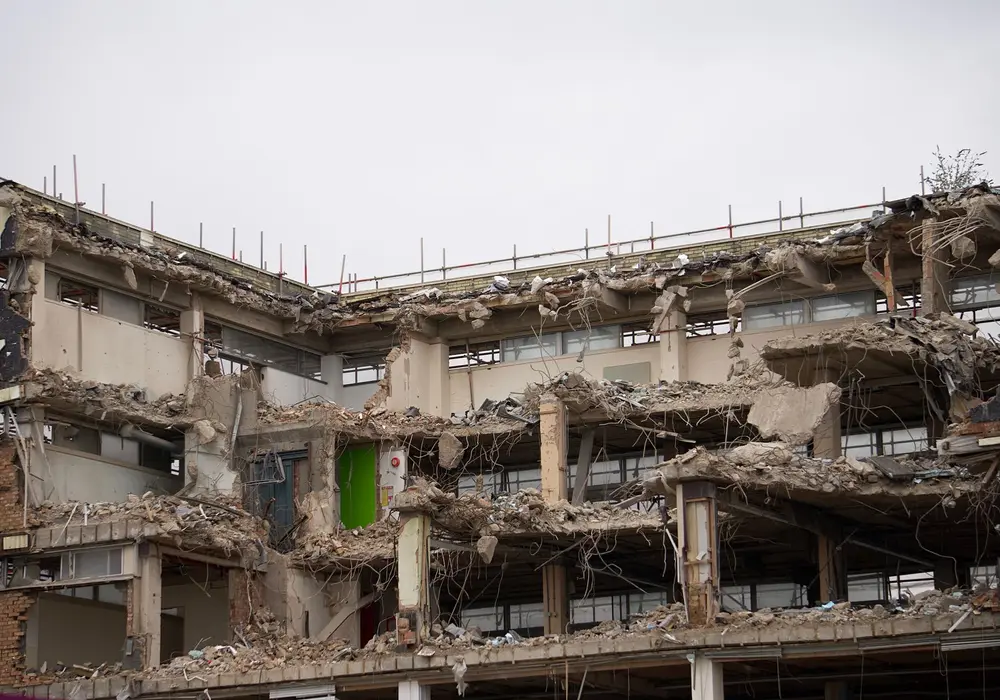
Once the units are empty, roofing comes off, the wood framing is pulled down with an excavator and grapple, and lumber is separated from drywall and stucco. Carports, laundry rooms, fences and pool decks around the complex are cleared with the buildings. The concrete slab or the perimeter footings and piers come out last, followed by backfill, compaction and rough grade.
Working Beside Close Neighbors on Apartment Demolition Sites
Multifamily lots in older neighborhoods are tight. Side setbacks may be a few feet, street parking is scarce, and trucks share narrow streets with residents. We set up fencing with screening, keep water on the work to suppress dust, and plan truck loading so the street stays passable. Where a building sits close to a neighbor's wall, the closest section is pulled away from that neighbor rather than toward it.
Neighbors get notice before heavy work starts, and work runs within the city's construction hours. Utility disconnects on a multifamily building involve several meters: PG&E or the local municipal utility pulls each gas and electric meter, the water agency closes the service, and the city inspects the sewer cap before it is buried.
Related Commercial Demolition Services
Commercial Demolition
Warehouse & Industrial Demolition
Office Building Demolition
Retail & Strip Mall Demolition
Restaurant Demolition
Gas Station Demolition
Steel Structure Demolition
Apartment & Multifamily Demolition Across the San Francisco Bay Area
Can an occupied apartment building be demolished?
No. The building must be fully vacated under whatever tenant rules apply in that city before a demolition permit is used. Those requirements are handled by the owner and their advisers; we start once the building is empty and the permit is issued.
Does every apartment unit need an asbestos survey?
The survey covers the whole building, which means sampling representative materials in units and common areas. Units remodeled at different times can have very different materials, so the consultant checks for those differences.
What happens to appliances in an apartment complex?
Refrigerators and air conditioners have their refrigerant recovered by a certified technician, then go to metal recycling with water heaters and ranges. Owners can also donate working appliances before demolition.
How are neighbors protected during multifamily demolition?
With screened fencing, water for dust control, advance notice of heavy work, truck loading planned to keep the street open, and structures pulled away from neighboring buildings. Work stays within the city's allowed hours.
Get a Multifamily Demolition Quote
Call or request a quote with the address, the number of buildings and units, and how far the city approvals have progressed. A site walk follows, along with a written scope and the permit conditions we expect.
- Email: contact@sfbayareademolitioncontractor.com
- Serving all 9 Bay Area counties from San Jose