

Mold Remediation Coordination
Mold Remediation and Water-Damaged Building Demolition in the Bay Area
When a building has stayed wet too long, mold shapes how the demolition is run. We bring in an assessor and a remediation contractor where the scope needs them, then run our demolition so damaged material leaves without spreading spores into what stays.
Where Mold Shows Up Before a Bay Area Demolition or Remodel
Mold needs moisture and time, and Bay Area buildings supply both in predictable places. Crawl spaces under older homes in the coastal fog belt stay damp most of the year. Bathrooms without an exhaust fan rot the subfloor around the toilet. Winter storms push water through tired roofs and soak attic sheathing. Vacant commercial buildings with failed roofs or broken plumbing grow mold for months before anyone looks. Homes hit by fire are usually soaked by firefighting water too, which feeds growth in walls and insulation within days.
Owners usually find it in one of three ways: during a remodel when the drywall comes off, during an inspection before a purchase, or when a building that has sat empty for a long time is finally opened for demolition. Each case raises the same questions. How far does the damage reach? Is any of the structure staying? Does the mold have to be removed before the rest of the work, or can it leave with the demolition debris?
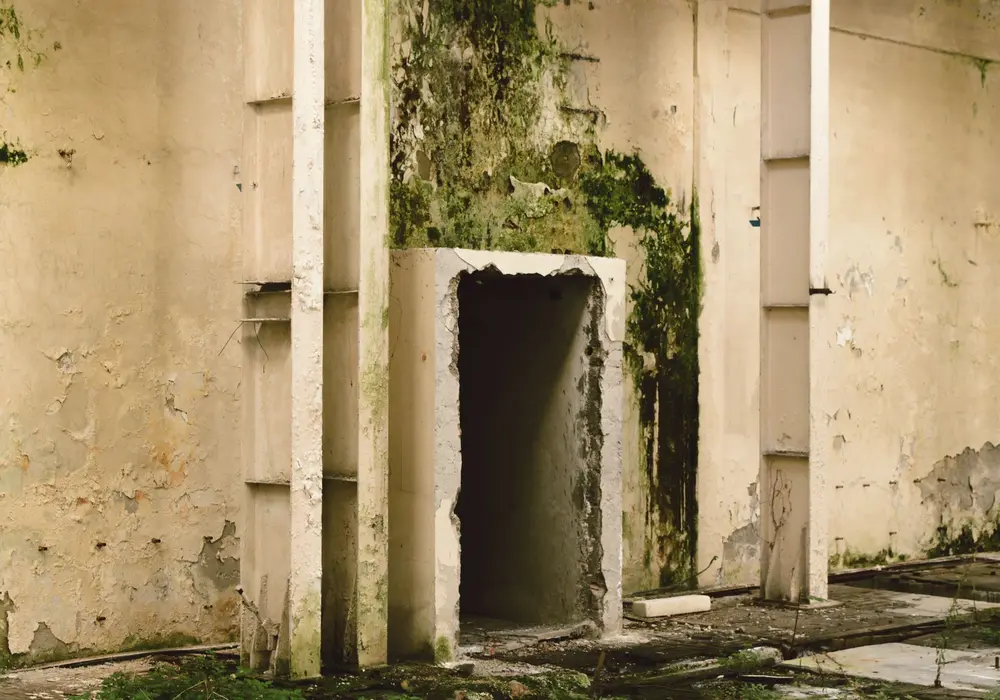
Mold Remediation Before Selective Demolition Versus a Full Teardown
If part of the building is staying, remediation comes first. Spores travel on air currents, so opening walls carelessly in an occupied house or a remodel can move contamination into rooms that were clean. A remediation contractor isolates the affected area, removes damaged drywall, insulation and wood under containment, and cleans what remains. Our selective demolition crew works around that containment and takes over the area once it is released.
If the whole building is coming down, the answer is often simpler. Mold-damaged materials can usually leave with the demolition debris, provided workers wear proper respiratory protection, the site is kept wet, and debris is loaded promptly into covered containers. The exception is a building where mold sits alongside asbestos or lead materials that still need abatement; then the abatement contractor's containment governs both. The hazmat survey and our site walk tell us which situation we are dealing with.
Who Assesses and Removes Mold on a Demolition Project
California has no dedicated state certification for mold remediation comparable to its asbestos and lead programs, which makes choosing the right people more important, not less. For anything beyond a small, obvious patch, we recommend an industrial hygienist or qualified environmental consultant to assess the building, trace the moisture source and write a remediation protocol. A remediation contractor follows that protocol, and the consultant performs clearance checks at the end. We schedule all three around our demolition.
Our crew handles the demolition that surrounds remediation. That can mean removing damaged framing or subfloor once the remediation contractor has contained and cleaned the area, hauling bagged material, and opening up construction so the water source can be repaired: pulling a deck ledger that let rain into a wall, breaking out a section of slab over a cracked drain line, or tearing out a failed exterior stair. Fixing the water is what keeps mold from returning.
How Mold Remediation Works Alongside Demolition, Step by Step
Moisture and Mold Assessment
An industrial hygienist or environmental consultant inspects the building, maps moisture, identifies the water source and, where useful, samples. The written protocol that follows defines what gets removed, what gets cleaned and how the work zone has to be contained.
Mold Remediation Protocol and Containment
The remediation contractor seals affected rooms with plastic, sets up HEPA air machines for negative pressure, and protects the rest of the building. On a full teardown, our crew instead plans wet demolition and respiratory protection for the mold-affected areas.
Removing Mold-Damaged Materials and the Water Source
Porous materials are cut out and bagged, framing that stays is cleaned, and our crew removes structure that cannot be saved. We open whatever construction is hiding the leak, whether a failed ledger, a cracked drain line or a broken stair.
Mold Clearance Before Rebuild or Demolition
The consultant checks the work visually, confirms the framing has dried to target moisture, and samples where the protocol requires it. Only after that sign-off do new walls close, or does the next phase of demolition continue.
Containment and Removal of Mold-Damaged Building Materials
Remediation follows a sequence that resembles asbestos work on a smaller scale. The work area is sealed with plastic sheeting and kept under negative pressure with HEPA air machines. Porous materials that are moldy, such as drywall, batt insulation, carpet and ceiling tile, are cut out and bagged inside the containment. Structural wood that can stay is cleaned by HEPA vacuuming and wiping. Fans and dehumidifiers then dry the framing to a target moisture content before anything new is installed.
- Moisture mapping to find the full extent of wet material
- Plastic containment and negative air on affected rooms
- Removal of porous materials that cannot be saved
- HEPA vacuuming and cleaning of framing that stays
- Drying to a target moisture level before rebuild
Mold in Fire-Damaged Homes and Long-Vacant Commercial Buildings
Two kinds of Bay Area projects bring mold and demolition together most often. After a house fire, water from the hoses sits in walls, ceilings and the crawl space while insurance and permits are sorted out, and mold grows in whatever survived the flames. On a fire-damaged demolition, ash and debris may also contain asbestos and other hazards, so the survey and the debris plan cover all of it, not only the mold.
Long-vacant commercial space is the other case: a closed restaurant, an older office with a failed roof, a warehouse where the sprinkler system leaked. Before our crew starts a strip-out, the consultant assesses conditions, and heavily affected areas are remediated or isolated. Workers wear respirators, and the space gets airflow controls during the strip-out so spores do not drift into an occupied tenant space next door.
Mold Remediation Cost and Clearance Before Rebuilding
Remediation cost rises with the affected area, the number of rooms needing containment, how much material is beyond saving, and whether hidden spaces like crawl spaces and wall cavities are involved. Assessment and clearance by the consultant are billed separately. On a full demolition, remediation cost can drop sharply because damaged material leaves with the rest of the debris. On a partial demolition or remodel, skipping proper remediation tends to cost more later.
Clearance matters most just before walls close. A visual inspection, moisture readings and, where the protocol calls for it, air or surface sampling confirm the area is ready for new framing, insulation and drywall. We do not hand a space over to the rebuilding contractor until the consultant has signed off, because covering active growth or wet framing with new finishes simply restarts the problem.
Related Hazardous Material Abatement Services
Hazardous Material Abatement
Asbestos Abatement
Lead Paint Abatement
Underground Storage Tank Removal
Septic Tank Removal
Pre-Demolition Hazmat Survey
Mold Remediation Across the San Francisco Bay Area
Do I need mold remediation before demolishing a whole house?
Usually not as a separate step. When the entire structure is coming down, mold-damaged materials can generally leave with the demolition debris under wet methods and proper respiratory protection. Remediation first becomes important when part of the building stays or when the mold is mixed with asbestos or lead that needs abatement.
Is moldy drywall considered hazardous waste?
Mold-damaged drywall and insulation are generally handled as ordinary construction waste, bagged and sealed so spores do not escape, though they are poor candidates for recycling. If the same materials contain asbestos, they follow the asbestos rules instead.
Who should test for mold before a remodel or partial demolition?
An industrial hygienist or qualified environmental consultant who is independent from the remediation contractor. Keeping assessment and removal separate avoids a conflict of interest, and the same consultant can perform clearance at the end.
Does mold remediation fix the leak that caused it?
Not by itself. Remediation removes the growth, but the water source has to be repaired or the mold returns. Our crew often handles the demolition needed to reach that source, such as a failed deck ledger, a broken drain line or a leaking exterior wall.
Can we live in the house during mold remediation?
Sometimes, if the affected area is small and can be fully contained away from living space. For larger jobs or when the HVAC system is involved, moving out for the duration is usually the better choice. The consultant's protocol should address occupancy directly.
Request a Mold Remediation and Demolition Quote
Tell us the address, where the water damage is, and whether part of the building is staying. Every form request gets a reply within one business day, and an assessor can be brought in before the scope is set.
- Email: contact@sfbayareademolitioncontractor.com
- Serving all 9 Bay Area counties from San Jose