

Concrete Slab Removal
Concrete Slab Removal & Floor Breaking in the Bay Area
Garage floors, house slabs, warehouse floors and interior trenches all start with the same question: what's inside the concrete? We scan, saw and break slabs so that whatever is staying stays undamaged.
Garage, House and Warehouse Slabs: How They Differ
A detached garage floor is usually the simplest slab around: thin, lightly reinforced or not at all, and often cracked from decades of settling. A house slab-on-grade is thicker at the edges and under bearing walls, and it has plumbing running through it, typically cast iron or ABS drain lines sitting in the sand below. Removing it means dealing with those pipes and the plastic vapor barrier underneath, not just the concrete itself.
Warehouse and tilt-up floors in places like Hayward, Fremont, Santa Clara and the Concord industrial area are a different scale. They are thick, reinforced, cut into panels by control joints, and studded with anchor bolts from old racking or machinery. Some have pits, trench drains or sumps cast in. Floors under former machinery, chemical storage or vehicle service bays may need sampling before the concrete goes to a recycler, and we flag those areas early so testing doesn't hold up the schedule.
Post-Tension Slabs: Why Scanning Comes Before Breaking
A post-tensioned slab looks like any other floor, but it holds steel cables pulled tight after the concrete cured. Those tendons carry a great deal of stored force. Cutting one carelessly can release it suddenly, damaging the slab and endangering anyone nearby. Post-tensioned slabs appear in some newer homes, in podium buildings and in many parking structures, and a stamped warning near the garage door is one clue, though not every slab has one.
Before we cut or break any slab that might be post-tensioned, we check the plans if they exist and scan the concrete with ground-penetrating radar to map the tendons. Full removal of a PT slab follows a de-tensioning sequence, sometimes involving a specialist, rather than straight breaking. The same scanning finds radiant heating tubing, buried conduit and conventional rebar, so it's standard practice for us on interior and partial removals even when PT isn't suspected.
Interior Slab Removal Inside an Existing Building
Tenant improvements, restaurant build-outs, ADU conversions and lab fit-outs often need slab removed inside a building that stays standing, and sometimes occupied. Typical jobs include trenches for new plumbing, larger areas for a new footing or equipment pit, and whole rooms where a floor has failed. Diesel machines don't belong indoors, so this work runs on electric breakers, electric saws with water feed, and compact demolition machines when the area justifies one.
Dust control is half the job. We put up plastic containment, run negative air machines where the space calls for it, and use wet cutting or vacuum shrouds in line with Cal/OSHA's silica rules. Debris leaves through doorways in buggies or small bins. When neighbors share walls, as they do in strip centers and mixed-use buildings, we schedule the loudest work for hours the property manager approves.
How Concrete Slab Removal Works, Step by Step
Survey and Scan the Slab
We review plans, check for post-tension stamps and scan the slab for tendons, rebar, conduit and tubing. Surface materials that may contain asbestos are matched against the survey before anything is cut.
Saw the Slab Into Manageable Sections
A flat saw cuts the outer edge and divides the slab into pieces sized for the equipment that will lift them. Wet cutting and slurry vacuums keep dust and runoff under control.
Break, Lift and Load the Concrete Slab
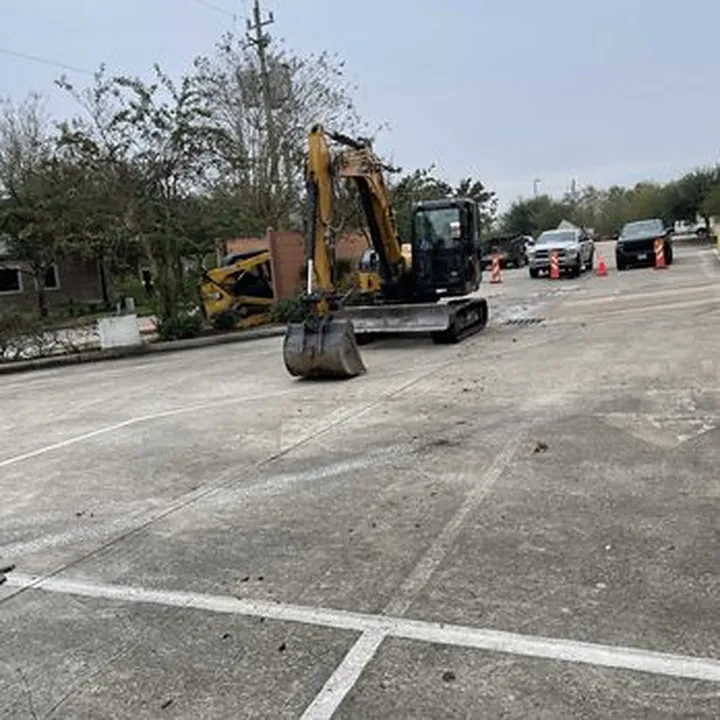
Sections are broken with a breaker or lifted out whole, and the rebar or mesh is separated from the concrete for scrap. Outdoors that means an excavator or skid steer; indoors, electric hammers and buggies.
Clear the Subgrade After Slab Removal
The vapor barrier and base are removed or kept as specified, under-slab pipes are capped or pulled, and the subgrade is cleaned and compacted for inspection or the next pour.
What Lies Under a Slab: Vapor Barrier, Base and Pipes
Under most residential slabs is a plastic vapor barrier over sand or gravel, and below that, native soil. Plumbing lines run through this layer, and in older buildings, so may abandoned pipes no one has used in decades. Electrical conduit, radiant tubing and heating ducts can be cast into the slab itself. Whatever stays has to be located and protected before breaking, and whatever goes gets cut, capped where needed and pulled out with the concrete.
The top surface matters too. Old vinyl floor tile and the black mastic beneath it can contain asbestos, and in a building headed for demolition those materials should already be on the asbestos survey. A certified abatement contractor we schedule removes them before our crew breaks the slab, so the concrete leaves the site as clean, recyclable rubble.
- Vapor barrier and sand or gravel cushion
- Under-slab drain lines and old abandoned pipe
- Conduit, radiant tubing or ducts in the concrete
- Floor finishes and mastic on top of the slab
Concrete Slab Removal for New Construction Pads
When a slab comes out to make way for a new building, the soils engineer usually wants to see the ground beneath it. We remove the concrete, the vapor barrier and the base layer, strip any soft or wet material the engineer flags, and leave the subgrade exposed for inspection. On large pads, crushing the old slab and reusing it as base for the new one can cut both truck traffic and the cost of imported rock, provided the engineer accepts the material and the site has room to process it.
Related Concrete Removal Services
Concrete Removal
Driveway Removal
Patio & Sidewalk Removal
Foundation Removal
Concrete Cutting & Sawing
Asphalt & Parking Lot Removal
Retaining Wall Removal
Concrete Crushing & Recycling
Concrete Slab Removal Across the San Francisco Bay Area
How thick a concrete slab can you remove?
Residential slabs, warehouse floors and heavy equipment pads are all within normal scope. Thickness changes the equipment and the time, not whether the slab can come out. Very thick or massive pours may be sawn into blocks first.
Can you remove a slab inside a building that's still in use?
Yes. Interior work uses electric equipment, plastic containment and dust collection, with loud work scheduled around the occupants. Debris leaves in small loads through doorways.
What if my slab has a post-tension warning stamp?
Don't cut or drill it yourself. We map the tendons with scanning and plan the removal so cables are released safely, bringing in a post-tension specialist when the job calls for one.
Is floor tile glued to the slab a problem?
It can be. Older vinyl tile and its mastic may contain asbestos, so samples get tested first. A positive result means a certified abatement crew, scheduled by us, strips the floor before our breakers start.
Request a Slab Removal Quote
Call (510) 826-3578 or describe the slab on our quote form, including where it is and whether the building is occupied. Expect a reply within one business day of your form request.
- Email: contact@sfbayareademolitioncontractor.com
- Serving all 9 Bay Area counties from San Jose