

Whole House Demolition
House Demolition and Tear-Down Services Across the Bay Area
Taking a house down to bare dirt ends one project and starts the next. We handle the demolition so your architect, engineer and builder inherit a permitted, compacted lot with nothing buried in it.
When a House Tear-Down Makes More Sense Than a Remodel
Owners usually arrive at a full tear-down after the remodel numbers stop working. Foundations without anchor bolts, framing too light to carry a second story, a failing sewer lateral and a floor plan that fights every change all push a project toward starting over. Zoning plays a part as well. A new house can often be larger, taller or better placed on the lot than the original allows, and your city's setback and floor-area rules decide how much you gain.
That choice has to be checked against local rules before it is final. Some cities send the demolition of a sound house through a planning hearing, and older homes may need a historic resource evaluation. Your designer files those, but they control the first day of demolition, so we plan around them and get the asbestos survey started early so it never becomes the bottleneck.
House Demolition Permits and the Paperwork Behind Them
A building division does not issue a house demolition permit on request. It wants a stack of supporting documents first, and a single missing page can push a start date back.
We assemble the demolition-side items, request the utility disconnects and keep a copy of each clearance with the permit so the inspector has everything at the site. If a permit expediter or general contractor is running the file, we feed them the pieces that come from us and stay off their toes.
- Asbestos survey by a certified asbestos consultant
- Air district demolition notice under BAAQMD Regulation 11 Rule 2
- Clearance letters from the gas, electric and water providers
- Sewer lateral capping plan and inspection request
- Construction waste management plan for CALGreen diversion
- Erosion control and tree protection details, where the city asks
Utility Disconnects Before a House Comes Down
Gas and electric are removed first, and the utility does that work itself. Across most of the region that means PG&E removing the gas meter, cutting the service at the main and dropping the overhead or underground electric feed. In the city of Santa Clara, Silicon Valley Power handles electric; Palo Alto runs its own utility; the island city of Alameda has Alameda Municipal Power. Each keeps its own request queue, so we file as soon as an owner confirms the job.
Water is shut at the meter by the water provider, and we often keep a temporary connection for dust control. The sewer lateral is cut and capped near the property line, and many cities inspect that cap before it is buried. If the lateral is old clay pipe, the city may require a new one with the new house, which the plumber handles later. Phone and cable lines are pulled off the structure too.
How House Demolition Works, Step by Step
Site Visit and House Demolition Scope
We walk the house, attic and crawlspace, measure flatwork and check street access. The written scope lists every structure, slab and tree to remove or protect, and who files which part of the permit.
Surveys, Abatement and Utility Shutoffs
A certified consultant surveys for asbestos and checks paint for lead. Any abatement is done by a certified contractor we coordinate. Gas, electric, water and sewer are disconnected and capped by the parties responsible for each.
House Demolition, Sorting and Haul-Off
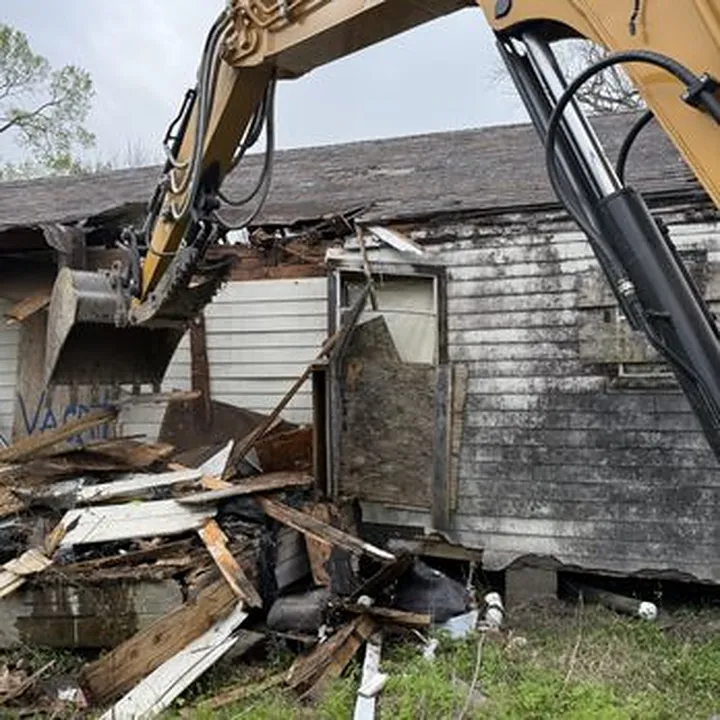
Salvage and the interior strip come first. The roof and framing then come down inward with an excavator, and wood, metal, concrete and mixed debris are separated as they are loaded and trucked to recyclers.
Foundation Removal and Rough Grade
Footings, slabs and flatwork are broken out, voids are backfilled and compacted, and the lot is rough graded. Facility receipts go to you for the city's diversion report and final inspection.
Taking the House Down: Strip, Salvage and Machine Demolition
The excavator is not the first thing on site. Before it arrives, the crew removes whatever would contaminate a recycling load or whatever is worth saving: appliances, carpet, insulation, fixtures, and anything the owner wants to keep or donate. Then the roofing comes off, and the excavator with a thumb pulls framing toward the middle of the footprint while laborers separate lumber, metal and drywall into their own piles.
In older homes with plaster walls, the plaster and lath come down with the framing but are loaded on their own where a recycler takes them. Water is sprayed on the work face the whole time. Trucks load inside the lot or at a staging spot the city has approved, never parked across a neighbor's driveway, and on narrow streets we switch to smaller trucks and more trips.
Foundation Removal, Backfill and Building Pad Preparation
With the walls gone, the foundation becomes the heavy part. Perimeter footings and stem walls are broken with a hydraulic breaker or pried up with the bucket, piers are dug out, and slabs are cut into pieces the concrete recycler can accept. Eichler slabs with radiant tubing cast inside take longer, since the metal has to be pulled from the concrete. Basement walls and floors come out to the depth the plans call for.
Fill goes back in lifts and is compacted, and if your geotechnical engineer wants density tests we schedule around their visits. The result is a rough graded pad, erosion control left in place, no roots or buried concrete, and the capped utility locations marked so the builder can find them without digging blind.
House Demolition Cost and Timeline Factors
Size is where pricing starts, not where it ends. A single-story slab ranch can cost less to clear than a smaller two-story home on a hillside, because the hillside job needs more hand work, smaller trucks and more trips. Abatement scope, concrete volume, a basement, tree protection fencing and the distance to recycling facilities all move the figure. A home with a pool, a detached garage and a long driveway is really four demolitions on one parcel, priced together.
The schedule follows the same logic. Machine work on a typical house is the short stretch. Permit review, abatement and the wait for the utility to remove service fill most of the calendar. Starting the survey and the utility requests the week you decide to rebuild is the most reliable way to shorten the whole project.
Related Residential Demolition Services
Residential Demolition
Garage Demolition
Shed & Outbuilding Removal
Deck & Patio Cover Demolition
Swimming Pool Removal
Mobile Home Demolition
Fire-Damaged Home Demolition
Partial Home Demolition
Chimney Removal
House Demolition Across the San Francisco Bay Area
How long does it take to demolish a house?
Machine work on a typical single-family house is measured in days, though basements, large slabs and hillside access add time. The longer part comes before it: permit review, the asbestos survey, abatement and the utility disconnect date. We give a working timeline after the site visit.
Can I keep living in the house until demolition starts?
Until the utilities are removed, yes. Most owners move out shortly before gas and electric service is pulled, which usually happens close to the start date. The asbestos survey can be done while the home is still occupied.
Can I salvage cabinets, doors or flooring before the tear-down?
Yes. Tell us what you want to keep and we either leave time for you to take it or remove it carefully during the strip. Reuse groups often accept doors, windows and fixtures, which also counts toward diversion.
Does the city inspect a house demolition?
Usually at the sewer cap and at final, and sometimes for erosion control or tree protection mid-job. The inspector confirms the lateral is capped correctly, the site is clean and the recycling has been documented.
What happens if the house has a basement?
Basement walls and the floor are broken out to the depth the plans require, then the hole is filled in compacted lifts. If the new house has its own basement, we leave the excavation as the builder's plan directs instead.
Get a House Demolition Quote
Send the property address and what you plan to build, or call (510) 826-3578. Within one business day we get back to you to book a walk-through of the house.
- Email: contact@sfbayareademolitioncontractor.com
- Serving all 9 Bay Area counties from San Jose