

Site tree and stump removal
Tree and Stump Removal for Bay Area Building and Demolition Sites
Trees in the way of a new foundation, driveway or utility trench have to come out roots and all. We remove permitted trees on construction and demolition sites, grind or excavate the stumps, and protect the trees that are staying.
Tree Removal Permits and Protected Trees in Bay Area Cities
Ask before you cut is the rule almost everywhere around the bay. Many cities protect trees above a certain trunk size, and most give extra protection to native species such as coast live oak, valley oak and, in some places, redwood or bay laurel. Some cities designate heritage trees individually. Street trees in the planting strip usually belong to the city and are handled through the public works or urban forestry office, not the building department.
The permit process often asks for an arborist report describing the tree's condition and why removal is needed, and the city may require replacement planting or an in-lieu payment. On a project with a building permit, approved tree removals are usually shown on the site plan. We do not cut a tree until the permit or plan approval is in hand, because removing a protected tree without one can bring fines and stop the larger project.
Sectional Tree Removal and Felling Around Structures
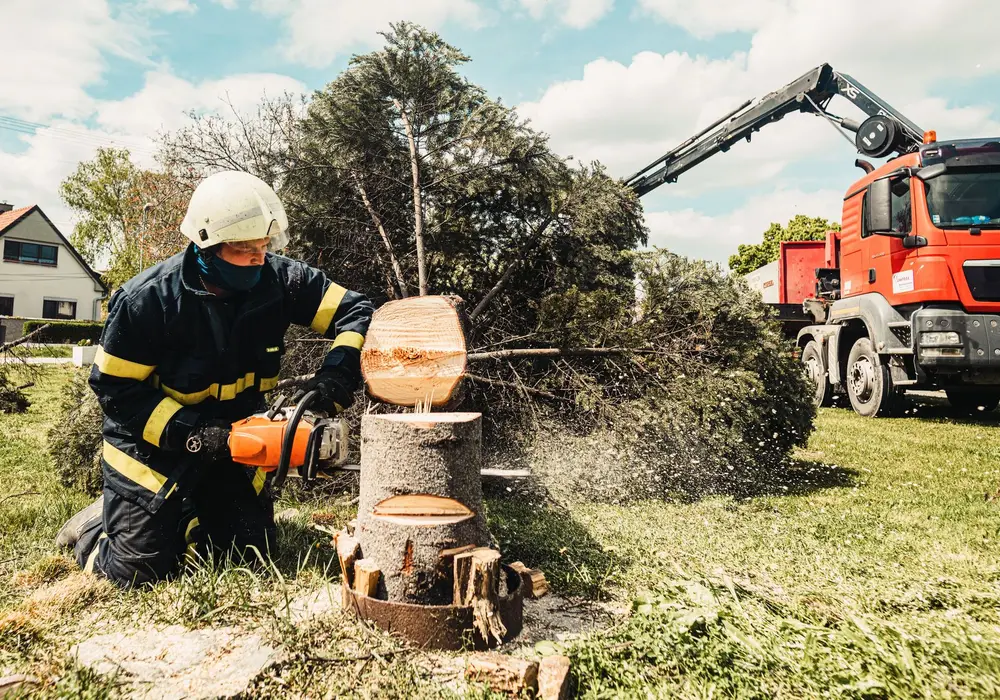
A tree in the middle of an open lot can often be felled in one piece toward a cleared drop zone. Most trees on Bay Area building sites are not that lucky. They lean over a garage, stand three feet from a neighbor's fence, or tangle with service drops. Those trees come down in sections: a climber or lift removes limbs, then the trunk is cut in short pieces lowered with ropes so nothing swings into a roof.
Very large trees close to buildings sometimes call for a crane to lift sections out. Trees touching or near energized power lines are a separate matter: only qualified line clearance workers can work near them, so we ask PG&E or the local municipal utility to clear or de-energize the lines first. Once the wood is on the ground, the excavator with a thumb or a loader moves logs to the processing area.
Stump Grinding or Full Stump Excavation on a Building Site
Grinding and digging solve different problems. A stump grinder chews the stump down below grade and leaves the main roots in the soil. That is fine in a lawn or planting bed where nothing structural will go. Under a foundation, slab, driveway or utility trench it is the wrong answer, because buried roots decay over the years and leave voids that let soil settle.
Inside the building footprint, we excavate the stump and the root ball with an excavator, pull lateral roots that run under the pad, and remove the loose soil around them. The hole is then backfilled with suitable soil placed and compacted in lifts so the soils engineer sees a uniform surface. Outside structural areas, grinding to the depth the owner wants is usually enough, and the grindings can be raked out or hauled.
- Grinding for lawns and planting areas
- Full excavation under slabs and footings
- Lateral roots pulled from trench and pad zones
- Holes backfilled and compacted in lifts
How Tree and Stump Removal Works, Step by Step
Confirm Tree Permits and Arborist Findings
We review the approved site plan, tree permit and arborist report to confirm which trees come out and which stay. Protection fencing for retained trees goes up before any tree removal begins.
Set Up the Drop Zone and Check Overhead Utility Lines
The work area is cleared and marked, neighbors are told when cutting will happen, and the utility is contacted if branches reach power lines. Roofs, fences and hardscape near the tree are protected.
Take Down the Tree and Process the Wood
The tree is felled or removed in sections depending on space. Limbs are chipped, logs are cut to manageable lengths, and material is sorted for mulch, firewood or green waste recycling.
Grind or Dig the Stump and Backfill the Hole
Stumps outside structural areas are ground below grade. Stumps under future foundations or driveways are excavated with their root balls, and the hole is filled and compacted in layers.
Protecting the Trees That Stay During Site Work
On many projects the trees being saved matter as much as the ones coming out. Cities that protect trees commonly require fencing around the root zone of retained trees before work starts, and the project arborist may set that fence well outside the trunk. Inside it, no parking, no stockpiles, no washing out equipment and no trenching without the arborist's approval.
When roots of a protected tree must be cut for a foundation or utility line, the arborist usually wants them cut cleanly by hand rather than torn by a bucket. We dig carefully at the edge of the protection zone, expose roots for the arborist to evaluate, and make clean cuts where directed. Mulch over the root zone and temporary irrigation during long dry projects are other common requirements we can work around.
Eucalyptus, Palm, Oak and Redwood Removal Considerations
Species changes the job. Blue gum eucalyptus, common across the East Bay hills and older Peninsula estates, is heavy, brittle and quick to resprout from a cut stump, so stumps usually need full removal or follow-up treatment. Palms have dense fibrous trunks and a root plug that grinders handle poorly, so excavating the root ball is often simpler. Mature oaks are frequently protected and may only be removed with a strong reason documented by an arborist.
Coast redwoods sprout vigorously from the base and their roots spread wide, which matters next to a new foundation. Monterey pines and cypresses drop heavy limbs and carry plenty of pitch. Knowing these habits ahead of time lets us plan the right equipment, the right disposal route and whether the stump can stay or has to come out.
What Happens to Logs, Chips and Green Waste
Wood from a site rarely needs to go to a landfill. Branches and brush run through a chipper, and the chips can be left for the owner as mulch or hauled to a composting facility. Clean logs may go to firewood processors or mills when the species and size make that worthwhile. Stumps and root balls, which carry soil and rock, typically go to green waste facilities that can grind them.
Sorting wood separately from soil, concrete and metal helps a project hit the CALGreen 65 percent diversion target for its job waste, and it keeps disposal costs lower. Weight tickets for green waste loads go into the same diversion report as the rest of the project.
Related Site Clearing Services
Site Clearing
Land Clearing
Lot Clearing for New Construction
Excavation & Grading
Debris Hauling
Construction Cleanup
Brush & Defensible Space Clearing
Tree & Stump Removal Across the San Francisco Bay Area
Do I need a permit to remove a tree before building?
Often, yes. Many Bay Area cities protect trees above a set trunk size and certain native species, and street trees usually belong to the city. If your project has a building permit, approved removals are typically shown on the plans. We confirm the permit status before cutting.
Is stump grinding enough if I am building over the spot?
No. Grinding leaves the root system in the ground, and roots under a slab or footing rot and cause settlement. Under any structural area, the stump and root ball should be dug out and the hole compacted in lifts.
Can you remove a tree that is near power lines?
Work near energized lines is limited to qualified line clearance crews. We contact PG&E or the local municipal utility to clear or de-energize the lines, then remove the rest of the tree once it is safe.
What if a protected tree's roots are in the way of my foundation?
The project arborist decides how much root loss the tree can handle. We expose roots carefully by hand, the arborist evaluates them, and any approved cuts are made cleanly. Sometimes the foundation design is adjusted to protect the tree.
Request a Tree and Stump Removal Quote
Tell us how many trees, their rough size, and whether a tree permit or arborist report already exists. Call (510) 826-3578 or use the quote form to start.
- Email: contact@sfbayareademolitioncontractor.com
- Serving all 9 Bay Area counties from San Jose