

Steel Building Demolition
Steel Structure Demolition and Metal Building Dismantling in the Bay Area
Steel frames come down by being cut, not crushed. We dismantle pre-engineered metal buildings, structural steel frames, mezzanines and canopies in a controlled order, test coatings before any torch work, and send the steel to scrap.
Types of Steel Structures We Demolish
Steel shows up across the Bay Area's commercial land in a few common forms. Pre-engineered metal buildings, with tapered rigid frames, girts, purlins and corrugated panels, house shops, storage, agricultural uses and light industry from Solano County farm roads to the industrial parks of the North Bay. Structural steel frames carry older industrial buildings, warehouses with steel roof trusses, and some office buildings. Inside buildings, steel mezzanines, equipment platforms and crane runways are frequently removed on their own.
Outside, canopies over fuel islands, loading docks and parking areas, pipe racks at industrial sites, and old steel water or feed structures round out the list. Each type has a different load path, and knowing how the loads travel through a structure is what makes dismantling it safe.
- Pre-engineered metal buildings
- Structural steel frames and roof trusses
- Mezzanines and equipment platforms
- Bridge crane runways and rails
- Canopies and pipe racks
Planning a Steel Demolition Sequence Around the Load Path
A steel frame is stable only as a complete system. Roof purlins and wall girts brace the main frames, cross bracing resists wind and earthquake loads, and moment connections hold columns upright. Remove the wrong piece first and a bay can rack sideways or a column can lose its bracing. Federal and Cal/OSHA demolition rules require an engineering survey of the structure's condition before work begins, and for larger or damaged structures we use a structural engineer's input on the sequence.
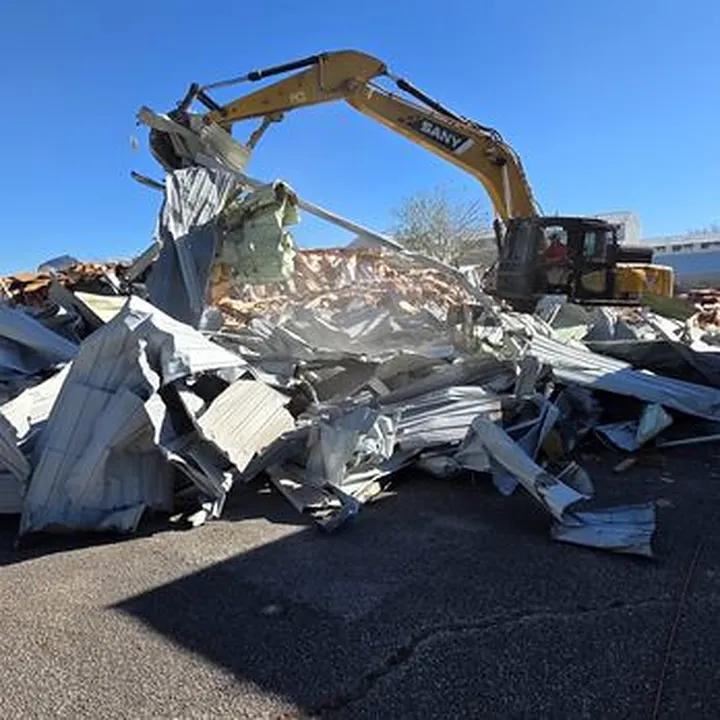
The general rule is to work from the top down and from one end toward the other, keeping each remaining bay braced until it is ready to come down. Roof and wall sheeting is stripped first. Purlins and girts come next, then bracing in a set order, then the main frames are taken down one at a time, either cut and lowered by crane or pulled down in a controlled direction with an excavator.
Shear Cutting Versus Torch Cutting on Steel Structures
A hydraulic mobile shear on an excavator cuts beams, columns and bracing from the ground without heat or sparks. It is faster, keeps workers off ladders and lifts, and avoids the fire risk of hot work near combustibles. On most metal buildings and frames within reach of the machine, shearing is the default method.
Torch cutting is still used for heavy sections, high connections and places a shear cannot reach. Older steel is frequently coated with lead-based primer or paint, and heating it releases lead fumes. Before any torch work, coatings are tested. If lead is present, the cut zones are stripped by a qualified crew or the cuts are moved to shear work, and hot work follows a fire watch and permit when the site requires one.
How Steel Structure Demolition Works, Step by Step
Steel Structure Survey and Coating Tests
We assess the frame, bracing and connections, sample paint for lead and coordinate the asbestos survey of the building. The engineering survey and the dismantling sequence are set before any steel is cut.
Sheeting, Insulation and Utility Removal
Utilities are disconnected and roof and wall panels come off, along with insulation and skylights. Any regulated materials found in the survey are removed by the certified abatement contractor first.
Controlled Steel Frame Dismantling
Purlins, girts and bracing are removed in order, then main frames are sheared or cut and lowered one bay at a time. Each remaining section stays braced until its turn.
Steel Sorting, Scrap Haul and Slab Work
Steel is cut to length and hauled to scrap. Base plates and anchor bolts are cut, and the slab and footings are either left for reuse or broken out and recycled.
Removing Mezzanines and Crane Runways Inside Standing Buildings
Interior steel removal is a common job by itself, usually when a building is being repurposed. A mezzanine is unloaded, its decking and guardrails removed, and the beams and columns are cut and lowered with a forklift, telehandler or small crane. Column base plates are cut flush with the slab or their anchor bolts ground down, and the holes in the floor are patched if the owner wants a clean surface.
Bridge cranes and their runway beams are heavier and higher. The crane bridge and hoist are rigged and lowered first, often by a crane company working with us, and then the runway beams and rails are removed bay by bay. The building's own columns may carry those runway brackets, so cuts are planned to leave the building frame intact.
Steel Scrap Recycling and Cost Factors in Steel Demolition
Steel is one of the few demolition materials with real resale value, and nearly all of it is recycled. Frames are cut to lengths the scrap yard accepts, separated from wood, insulation and roofing, and loaded onto trucks or roll-off bins. The scrap credit offsets part of the demolition cost, which we account for in the price.
The bigger cost factors are elsewhere: the height and span of the structure, whether lead-coated steel limits torch work, crane time for high or heavy pieces, how much insulation and sheeting need separate handling, and how close the structure is to other buildings or power lines. A metal building that stands alone on an open lot goes much faster than an interior mezzanine in a working plant.
Related Commercial Demolition Services
Commercial Demolition
Warehouse & Industrial Demolition
Office Building Demolition
Retail & Strip Mall Demolition
Restaurant Demolition
Gas Station Demolition
Apartment & Multifamily Demolition
Steel Structure Demolition Across the San Francisco Bay Area
Is it better to dismantle a metal building or demolish it?
If the owner wants to reuse or sell the building, it can be unbolted and dismantled piece by piece, which takes longer. If not, shear demolition is faster and the steel goes to scrap. We can price both.
Why do you test paint before cutting steel?
Older steel often carries lead-based primer. Torch cutting heats the coating and releases lead fumes, which puts workers at risk. Testing tells us whether to strip cut zones or use shears instead.
Can you remove a mezzanine without disturbing the building?
Yes. Mezzanines are taken apart in place and lowered with lifts or a small crane. Base plates are cut at the slab, and the building's structure is left untouched unless the scope says otherwise.
Does scrap steel reduce the demolition price?
It can. Steel has resale value at the scrap yard, and that credit is reflected in our price. How much depends on the tonnage and the market at the time of the job.
Request a Steel Structure Demolition Quote
Call or request a quote with the location, the type of steel structure and its rough size, and whether it stands alone or inside another building. We reply within one business day.
- Email: contact@sfbayareademolitioncontractor.com
- Serving all 9 Bay Area counties from San Jose