

Driveway Removal
Concrete & Asphalt Driveway Removal in the Bay Area
Breaking and hauling an old driveway rarely takes long. The permits for the apron, curb and sidewalk out front often set the real schedule, so we plan both halves of the job from the first visit.
Where Your Driveway Ends and the City Right-of-Way Begins
Most driveways are really two pieces of property. The slab running from the garage to about the back edge of the sidewalk belongs to you. The approach, the sloped apron that drops through the curb into the gutter, usually sits in the public right-of-way along with the sidewalk itself. Taking out the private section is ordinary demolition. Touching the approach, curb or sidewalk normally needs an encroachment permit from the city's public works or engineering division, or from the county road department on unincorporated land.
The city also decides what goes back. Approach width, slope, thickness and the joint where new concrete meets the gutter generally follow a standard detail, and an inspector may check the forms or subgrade before the pour. Widening a driveway or moving the curb cut can turn into a new-driveway application with its own review of street trees and lost curb parking. We confirm the scope with the permit counter before quoting, so the work we price matches what the city will sign off.
Why Bay Area Driveways Crack, Heave and Need Removal
Expansive clay causes much of the damage. Across the Santa Clara Valley floor and the East Bay flats, the soil swells with winter rain and shrinks through the dry months, lifting and dropping the slab until it breaks into plates. Large street trees push roots under the concrete and tilt whole panels. Driveways poured in the 1950s and 1960s ranch tracts were often thin, laid over little or no base rock and left without steel, so they crumble at the edges where tires turn.
Sometimes the driveway is sound and the plan changes. A backyard ADU needs a new path for cars or utilities, a garage conversion moves the parking, or an owner wants permeable pavers to keep rainwater on the lot. A wider pad for a second car or an EV charger is another common reason. In each case the old concrete comes out completely, because pavers and fresh concrete both need a uniform, compacted base beneath them, not a patchwork of old slab and new rock.
Driveway Removal Near Protected and Street Trees
The roots that wrecked a driveway are also the main constraint on removing it. Many Bay Area cities protect street trees and large private trees by ordinance, and cutting a major root can count as damage to the tree. When a driveway crosses the root zone of a tree that may be protected, we break the concrete into pieces and lift them straight up with the excavator bucket instead of dragging them across the ground. Machines stay off the root zone where possible, and if the city wants an arborist to direct root pruning, that happens before the new base goes in.
- Slabs lifted out rather than scraped across roots
- Hand tools used close to large roots
- Tree protection fencing left where the city placed it
- Arborist reports arranged when the permit requires one
How Driveway Removal Works, Step by Step
Locate Utilities and Pull the Approach Permit
We open an 811 ticket, look for private lines like irrigation and gate wiring, and file the encroachment permit if the apron, curb or sidewalk is part of the job. Nothing gets broken until the lines are marked.
Saw Cut the Driveway Limits
A flat saw cuts a straight line wherever the driveway meets concrete that stays, such as the garage slab, a walkway or a neighbor's drive. The cut keeps the breaker from cracking anything outside the work area.
Break, Load and Haul the Driveway Concrete
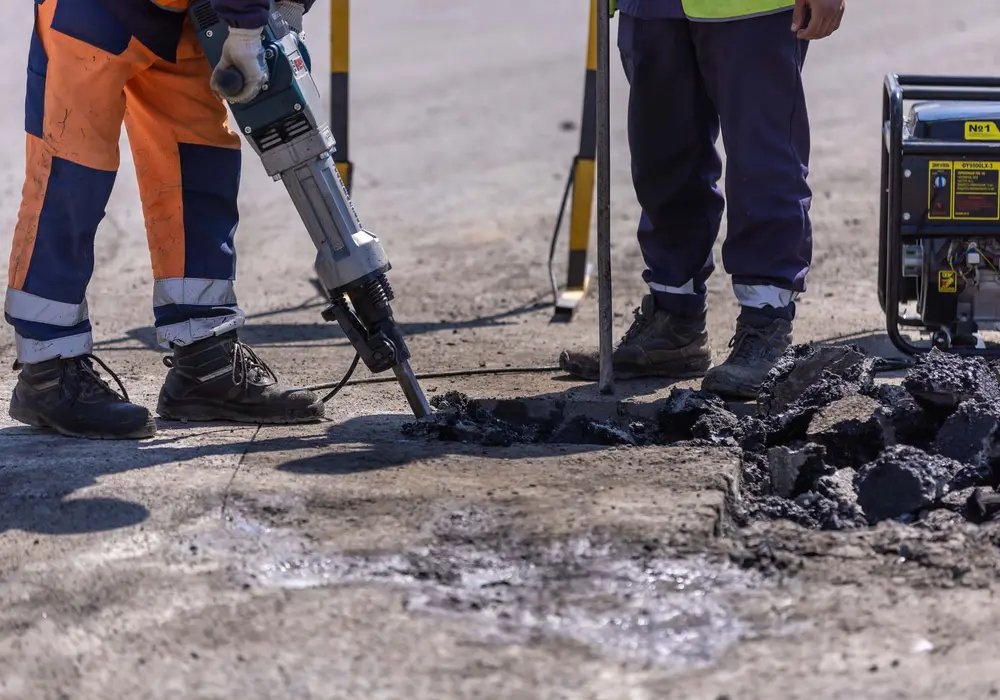
A breaker on a skid steer or excavator reduces the slab to pieces a machine can lift. Concrete, asphalt and steel are loaded separately and hauled to recyclers, with water on the work to hold down dust.
Grade and Compact the Driveway Base
The base is dug to the depth the new surface needs, the subgrade is compacted, and the area is graded to drain. Your paving or concrete contractor arrives to a pad ready for forms or pavers.
Concrete vs Asphalt Driveway Removal: What Changes
Asphalt comes up faster. A skid steer bucket or excavator can usually peel it off the base without a breaker, and the material goes to a plant that mixes it into new paving. Concrete driveways with rebar or wire mesh need a hydraulic breaker and extra time to pull the steel out of the rubble. Some driveways are both, an old slab buried under an asphalt overlay or framed with a brick border, and each layer goes into its own load so the recycler takes it.
What runs under the driveway matters as much as what it's made of. The gas service to the meter, the water line from the street, the sewer lateral and its cleanout, and low-voltage wiring for gate openers or path lights often cross beneath it. We mark everything we can find before breaking. Where a line runs shallow, the crew works the concrete around it by hand rather than risk a cracked pipe.
Getting the Base Ready After Driveway Removal
Once the concrete is gone, the next question is how deep to dig. Clean, well-graded base rock under an old driveway can sometimes stay. Pavers typically want a deeper section, and permeable pavers sit on a thicker layer of open-graded rock that lets water soak through. We excavate to whatever depth your paving contractor or designer specifies, haul the spoils, compact the subgrade and leave it sloping toward the street or a drain instead of back toward the garage.
Plan for a few days without the driveway. Cars move to the street, and if a truck or bin has to sit in the roadway, some cities require a separate permit for that too. We try to time removal so the bare base doesn't sit open through a storm, since rain-soaked clay delays the next trade.
Related Concrete Removal Services
Concrete Removal
Patio & Sidewalk Removal
Foundation Removal
Concrete Slab Removal
Concrete Cutting & Sawing
Asphalt & Parking Lot Removal
Retaining Wall Removal
Concrete Crushing & Recycling
Driveway Removal Across the San Francisco Bay Area
Do I need a permit to remove my driveway?
The private section usually doesn't need one. The apron, curb and sidewalk in the right-of-way normally do, through the city's public works department. We check the local rules before quoting.
Can you remove only part of a driveway?
Yes. We saw-cut along the line where removal stops, break out only the damaged section, and leave a clean edge for the new concrete to meet. This is common when tree roots lift just one panel.
Will you take out the sidewalk and curb too?
If the city requires the approach or sidewalk to be replaced, or you want a new curb cut, we remove those sections under the encroachment permit. Many owners replace the apron at the same time so everything meets current city standards.
Can old driveway concrete be reused under the new one?
Not as broken slabs, which leave voids. Crushed and screened concrete makes good base, but that processing usually happens at a recycling facility. The old concrete goes there, and recycled base can come back for the new driveway.
How do you protect the garage slab during driveway removal?
We saw-cut a clean joint between the driveway and the garage slab before any breaking. The breaker then works away from the garage, so impact doesn't travel into the slab you're keeping.
Get a Driveway Removal Quote
Call (510) 826-3578 or fill out the quote form with your address and what's going in after the old driveway. We answer form requests within one business day.
- Email: contact@sfbayareademolitioncontractor.com
- Serving all 9 Bay Area counties from San Jose